
What Does ‘Cultural Awareness’ Mean?
Cultural awareness is an essential skill for professionals working across cultures and global teams. In today’s international workplace, it underpins intercultural communication, inclusive leadership, and effective collaboration. This guide explains what ‘cultural awareness’ means in practice, why it matters across sectors such as international business, healthcare, tourism, and NGOs, and how organisations can turn cultural awareness training into meaningful behavioural change and stronger engagement in global and virtual teams.

The Real Meaning of Cultural Awareness
Cultural awareness is often described as the ability to understand and respect cultural differences. In practice, this definition barely scratches the surface.
For professionals working in global organisations, NGOs, public services, or multicultural teams, cultural awareness is not about politeness or avoiding offence. It is about starting to develop the capability to recognise difference, interpret behaviour accurately, and respond in ways that support trust, inclusion, and performance.
As work becomes more international, more diverse, and more virtual, cultural awareness training is no longer optional. It underpins communication, leadership, engagement, and DEI outcomes across sectors. Without it, even highly skilled professionals can struggle to collaborate effectively or build sustainable working relationships.
Why Cultural Awareness Matters in Today’s Global Workplace
Today’s workplace is shaped by cross-border collaboration, remote and hybrid working, and increasingly diverse teams. Professionals regularly interact with colleagues, clients, and stakeholders who hold different assumptions about hierarchy, communication, decision-making, and accountability.
Cultural awareness matters because it helps people make sense of these differences without defaulting to judgement. When cultural awareness is low, behaviour is often misread as disengagement, resistance, or lack of capability. When it is high, difference is recognised as context rather than deficit.
From a DEI perspective, cultural awareness is foundational. Inclusion depends on recognising that people participate, contribute, and engage in different ways. Without cultural awareness, organisations risk creating environments that appear diverse but unintentionally favour one dominant way of working.
Cultural Awareness Isn’t About Not Offending People
Cultural awareness is often mistaken for cultural knowledge. Many organisations that invest in training for their employees focus on etiquette, greetings, or lists of dos and don’ts. While this information can be useful, it rarely prepares people for the realities of working across cultures.
Knowing how to greet someone does not explain why a colleague avoids public disagreement, remains quiet in meetings, or prefers indirect feedback. Cultural awareness goes beyond facts to examine values, expectations, and communication styles that shape everyday workplace behaviour.
When cultural awareness stops at knowledge, it can create false confidence. People believe they are prepared, yet still struggle to interpret behaviour or adapt their approach. True cultural awareness is dynamic and reflective. It requires curiosity, self-awareness, and the willingness to question assumptions.

Cultural Awareness Starts with Noticing Differences at Work
Cultural awareness begins with noticing difference rather than explaining it away. In the workplace, difference shows up in how people speak, listen, contribute, challenge ideas, manage time, and relate to authority.
What professionals need to notice in everyday workplace interactions
Small signals often carry significant meaning. Who speaks first in meetings, how silence is used, how directly feedback is given, and how decisions are framed all reflect cultural norms. In virtual teams, these signals can be amplified or misinterpreted due to the absence of context.
How assumptions form quickly and shape judgment
Humans interpret behaviour quickly. Without cultural awareness, professionals often rely on their own norms as the reference point. These assumptions can shape perceptions of engagement, competence, and motivation long before facts are established
Understanding What Behaviour Means Across Cultures
Noticing difference is only the first step. Cultural awareness requires interpretation: the ability to understand what behaviour may mean in different cultural contexts.
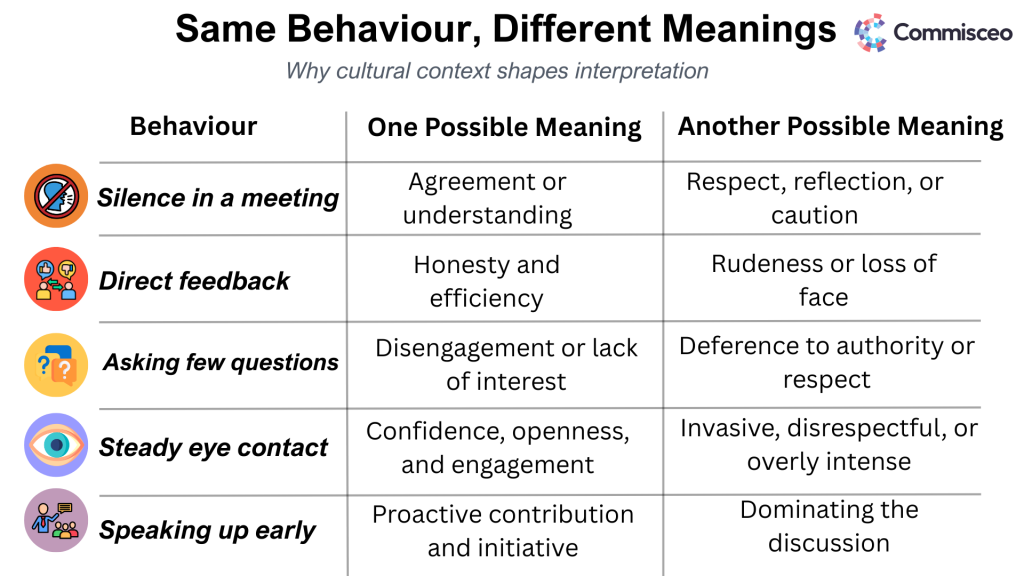
When silence, directness, or eye contact are misread
The same behaviour can be interpreted in very different ways. Silence may indicate agreement, respect, reflection, or discomfort. Direct communication may be valued as clarity in one context and experienced as bluntness in another. Eye contact may signal engagement for some and feel intrusive for others.
Why context matters more than intent in global teams
Intent alone does not prevent misunderstanding. Meaning is shaped by cultural context, power dynamics, and situational norms. Cultural awareness helps professionals interpret behaviour through context rather than personal preference, reducing friction and misalignment.
Turning Cultural Awareness into Effective Action
Cultural awareness only creates value when it translates into action. Insight on its own does not change how meetings unfold, how decisions are made, or how people experience inclusion day to day.
Effective cultural awareness shows up in what people do differently when they communicate, collaborate, and lead across cultures.
Adaptation is often misunderstood as compromise or loss of authenticity. In reality, it is about being intentional. It means recognising when your default approach may not land as intended and adjusting how you frame messages, invite contribution, or structure interaction so that collaboration works across cultural contexts. This is not about lowering expectations. It is about increasing clarity, fairness, and effectiveness.
Adjusting communication without losing credibility or authenticity
In practice, adaptation often involves small but meaningful shifts. This might include setting clearer agendas, explaining how decisions will be made, or being more explicit about expectations that are usually assumed. It may involve slowing down discussions to allow reflection, using multiple channels to gather input, or reframing feedback so it can be heard without loss of face or trust.
For leaders and managers, this kind of adjustment strengthens credibility rather than undermining it. Teams are more likely to engage when communication feels clear, respectful, and predictable. Cultural awareness enables leaders to adapt their style without becoming inconsistent, ensuring standards remain high while participation becomes more inclusive.
Building trust and working relationships across cultures
Trust does not develop in the same way everywhere. In some cultures, trust is built through delivery, reliability, and competence. In others, it grows through relationships, consistency, and personal connection. Problems arise when people assume their own trust building style is universal.
Cultural awareness helps professionals recognise these differences and respond intentionally. This might mean investing more time upfront in relationship building, following through more visibly on commitments, or explaining the rationale behind decisions rather than assuming alignment. Over time, these behaviours create trust that is resilient across distance, difference, and virtual working environments.
When cultural awareness is applied consistently, it shifts collaboration from friction to fluency. Teams communicate with greater clarity, leaders act with more confidence, and trust is built through understanding rather than assumption.
The Gap Between Cultural Awareness and Real Behaviour Change
Many organisations invest in cultural awareness training with positive intent, yet see little sustained change in how people actually behave at work. Awareness may increase understanding at a conceptual level, but everyday practices around communication, decision making, feedback, and leadership often remain untouched. As a result, the same misunderstandings, frustrations, and engagement issues continue to surface, particularly in global and virtual teams.
This gap exists because awareness alone does not equip people to act differently under pressure. Knowing that cultures vary does not automatically translate into knowing what to do in a difficult meeting, how to respond to silence, or how to manage disagreement without damaging trust. Without practical frameworks and shared expectations, cultural awareness remains theoretical and easily overridden by habit, time pressure, or organisational norms.
Where organisations and leaders typically struggle
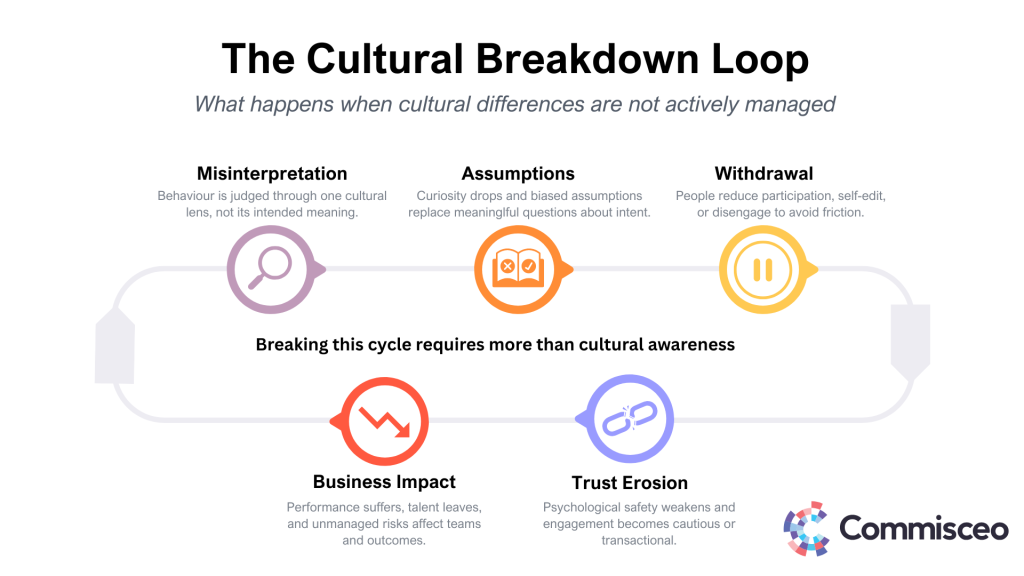
Leaders often recognise that cultural differences are present but feel uncertain about how to address them without causing offence, appearing biased, or losing authority. In the absence of clear guidance, many default to avoidance. Difficult conversations are postponed, assumptions go unchallenged, and misinterpretations quietly shape decisions about performance, engagement, and potential.
Over time, these patterns reduce inclusion. Some voices dominate while others withdraw. Behaviour is labelled as disengaged or uncooperative when it may simply reflect different cultural norms around hierarchy, communication, or risk. What begins as uncertainty gradually becomes normalised disengagement and mistrust.
Why awareness without skills can increase risk rather than reduce it
Awareness without practical skill can actually heighten risk. When people are aware that cultural differences exist but lack the tools to work with them, they may become overly cautious, hesitant to speak, or reluctant to intervene. This can lead to inconsistent leadership, unclear expectations, and reduced accountability.
In some cases, cultural awareness training raises sensitivity without providing direction, leaving managers unsure how to adapt without “getting it wrong.” Rather than improving inclusion, this can stall decision-making, weaken leadership confidence, and increase frustration on all sides. Sustainable behaviour change requires not just awareness, but applied skills, shared language, and organisational reinforcement.
Why Cultural Awareness Matters Across Sectors
Cultural awareness is relevant far beyond international business. Its impact varies by sector, but the consequences of misunderstanding are often more severe when people, safety, or reputation are involved.
Cultural awareness in healthcare, education, and public services
In healthcare and public services, cultural awareness supports trust, consent, safeguarding, and ethical decision-making. Misinterpretation can affect patient outcomes, service access, and confidence in institutions.
Cultural awareness in tourism, hospitality, and customer-facing roles
In customer-facing sectors, cultural awareness shapes service expectations, complaint handling, and brand reputation. Understanding cultural norms around politeness, time, and authority improves experience and reduces conflict.
Cultural awareness in international business, NGOs, and global teams
In international business and NGOs, cultural awareness underpins negotiation, partnership building, leadership, and virtual collaboration. It directly influences engagement, retention, and performance across borders.
Cultural Awareness and the Foundations of Belonging
Cultural awareness extends beyond the workplace. For international hires, global assignees, migrants, and refugees, work is only one part of the adjustment journey.

Why cultural awareness matters for people settling into a new country

For people relocating internationally, including immigrants and refugees, cultural awareness is critical to navigating everyday life as well as work. Understanding local norms, communication styles, and social expectations reduces uncertainty and emotional strain, helping individuals make sense of unfamiliar situations without constant self-doubt. When people feel better equipped to interpret what is happening around them, they are more likely to build relationships, seek support, and settle with confidence rather than withdrawal.
Social integration and well-being are closely linked to how people show up at work. When individuals feel isolated or struggle to connect outside the workplace, this often affects confidence, energy, and willingness to participate professionally. Cultural awareness supports wellbeing by helping people interpret behaviour accurately and avoid personalising difference. In turn, this creates the psychological stability needed for sustained engagement, collaboration, and contribution at work.
The role of employers in supporting cultural adjustment and inclusion
Employers play a significant role in shaping how well people adjust culturally, even beyond formal job responsibilities. When organisations acknowledge the broader challenges of relocation and integration, they create conditions for stronger belonging and retention. Providing cultural awareness support through onboarding, learning programmes, and inclusive leadership practices signals that people are valued as whole individuals, not just as roles or resources. Over time, this investment supports inclusion, engagement, and long-term performance.
What Cultural Awareness Looks Like as a Business Capability
When cultural awareness is treated as a capability, it moves beyond individual insight to organisational impact.
From individual awareness to organisational impact
Cultural awareness only creates impact when it moves beyond individual insight and becomes embedded in how an organisation operates. Individual awareness may improve isolated interactions, but organisational impact requires shared understanding, common language, and consistent expectations around behaviour. When teams lack this alignment, cultural awareness remains fragmented, uneven, and dependent on personal goodwill rather than organisational capability.
At an organisational level, cultural awareness shapes how decisions are made, how feedback is exchanged, how inclusion is practised, and how trust is built across teams. When these behaviours are reinforced consistently, cultural awareness shifts from being an individual attribute to a collective way of working that supports engagement, performance, and accountability across borders.
The role of L&D, HR, and global mobility in building capability
Learning and Development, HR, and global mobility functions are central to turning cultural awareness into sustained capability. This work goes far beyond one-off training sessions. It involves designing learning journeys that build understanding over time, equipping managers with practical tools to lead across cultures, and ensuring cultural awareness is reinforced at key moments such as onboarding, relocation, leadership transitions, and team formation.
HR and global mobility teams also play a critical role in setting expectations and providing support structures that reduce cultural risk. By integrating cultural awareness into policies, leadership development, and employee support systems, organisations create environments where inclusion is intentional rather than assumed. Over time, this approach strengthens engagement, retention, and trust, particularly in global and virtual teams where cultural dynamics are most visible.
Cultural Awareness is a Starting Point, Not the Goal
Cultural awareness creates insight, but insight alone does not change behaviour. Real impact comes when organisations turn awareness into practical capability that shapes how people communicate, lead, and collaborate across cultures. This is where many global teams need support.
At Commisceo Global, we help organisations move beyond awareness through practical, evidence-based training that builds confidence, shared language, and inclusive ways of working. If your teams operate across cultures, borders, or virtual environments, we can help you translate cultural understanding into measurable engagement, stronger relationships, and better outcomes.
Get in touch to discuss how our cross cultural training, workshops, and eLearning programmes can support your organisation.
You might also like these articles…

Vietnamese Business Communication Style
How Values Shape Business Communication in Vietnam Contents hide How Values Shape Business Communication in Vietnam Vietnamese Communication: Why Context Matters Three Vietnamese Values That…

How Mexican Cultural Values Shape the Workplace
Mexican Cultural Values at Work: Communication, Teamwork and Management Contents hide Mexican Cultural Values at Work: Communication, Teamwork and Management Key Insights: Mexican Cultural Values…

Cross Cultural Communication in Business and the Workplace
Business Examples and Insights into Cross Cultural Communication at Work Contents hide Business Examples and Insights into Cross Cultural Communication at Work What Is Cross…