
Germany Management Culture Guide
German business culture is structured, professional, and strongly influenced by expertise, planning, and reliability. The management style in Germany often emphasises technical competence, clear organisation, and well defined responsibilities. For international professionals managing teams in Germany, understanding German communication styles, leadership expectations, and decision making practices helps build trust and improve collaboration with German colleagues and organisations.

Management Style in Germany: A Guide for International Managers
Managing teams in Germany requires an understanding of the cultural values and workplace expectations that shape German work culture.
Leadership style, communication patterns, hierarchy, and decision making can differ significantly from those found in many North American and European organizations.
For international managers and professionals working with German colleagues, getting insights through a Germany cultural awareness training course helps improve collaboration, strengthen trust, and support effective leadership.
This management guide explores key aspects of management culture in Germany including leadership style, communication practices, decision making, and negotiation approaches.
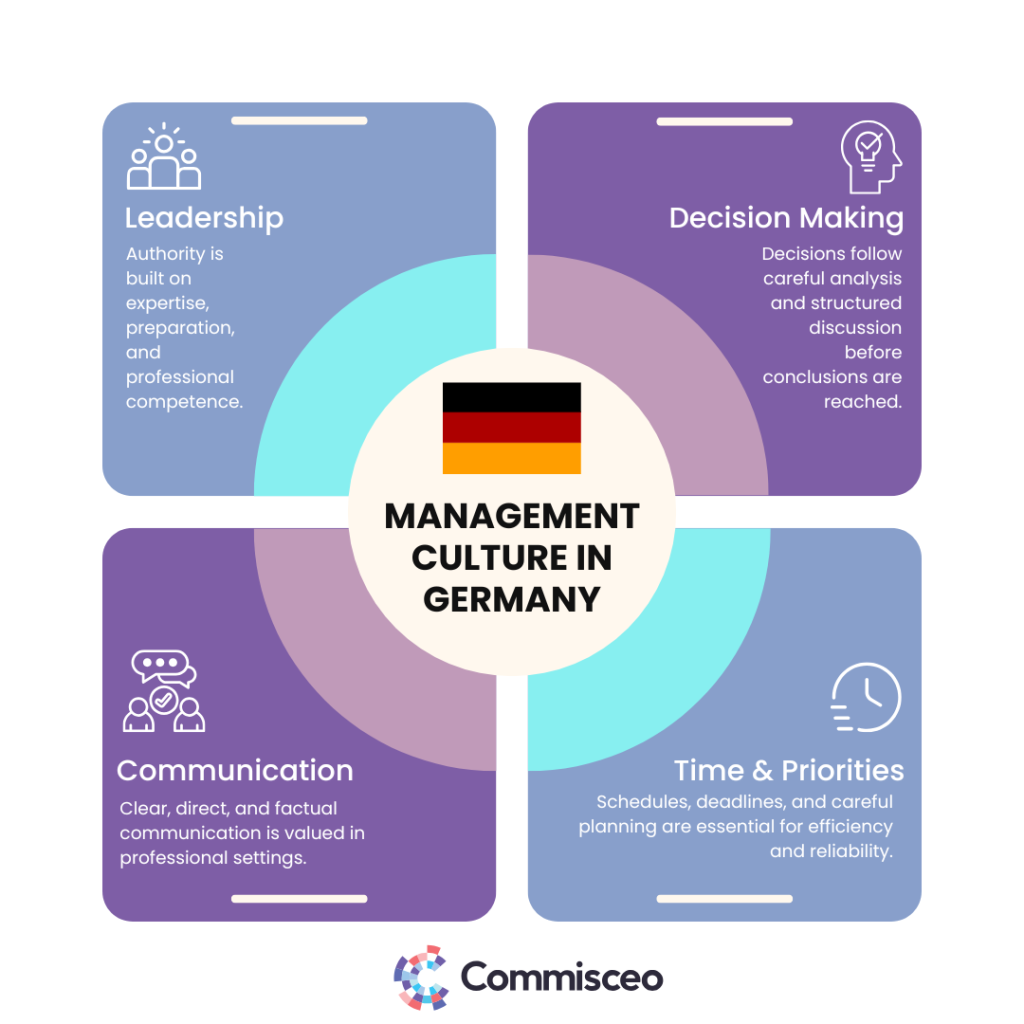
Being a Manager in Germany
The business culture in Germany is formal, with a hierarchy based on technical expertise and experience. You must be prepared for a host of regulations, guidelines, and principles covering every aspect of conducting business in Germany.
Additional considerations include:
- Transparency and respect for accurate detail are very important.
- You are likely to find, in this respect, that Germans place considerable emphasis on the quality and value of their materials, including excellent presentation.
- The Germans tend to be strong critical thinkers and to be open to new ideas and change where needed.
- This is a formal culture which believes that ‘time is money’.
- Relationships are clearly defined, which intimates the type of communication and behaviors expected.
- Some employees in Germany do not feel that they are authorized by station, education, or position to either aspire to leadership or to express themselves freely in management circles.
- Nevertheless, many do, and especially with the influence of globalization, organizations are tending to rely more heavily on the wisdom of their people and not just the direction of leadership.
Management in Practice:
Managers working in Germany benefit from demonstrating preparation and professional competence in meetings and discussions. Teams often expect leaders to be well informed and able to explain decisions clearly. Providing structured agendas, supporting arguments with evidence, and showing attention to detail can strengthen credibility and leadership effectiveness.

The Role of a Manager in German Business Culture
In German organizations, there is a clear chain of command in each department. Information and instructions are passed downwards. This does not mean, however, that German management is exclusively autocratic. There is also considerable value placed on consensus. Subordinates demonstrate their respect for their supervisors and managers by following their directions to the letter.
- In return, managers provide explicit directions and ensure their subordinates have the proper materials and understand the appropriate procedures.
- Productivity and delivery during normal office hours are valued and employees who consistently work outside of these hours are likely to be viewed as failing to manage their time properly.
- There is often a gulf between managers and their subordinates, although this is less so in newer companies, high-tech, or other high-growth industries.
- Managers are expected to give precise directions when assigning tasks so that there is no question about what is expected.
- It is important to note, however, that the workplace culture does not tolerate managers who are overly authoritarian in nature.
- Expertise and technical understanding are greatly respected in the workplace.
- If you work in Germany therefore, then it’s not considered immodest to communicate professional expertise or qualifications.
Management in Practice:
Managers in Germany are often expected to act as knowledgeable coordinators who ensure work is organized efficiently. Taking time to clarify processes, define responsibilities, and provide the right technical resources helps teams perform effectively. Managers who support structured working methods and clear accountability tend to gain respect from German colleagues.
Approach to Change in German Organizations
Germany’s cultural tolerance for change is low, meaning that social change is difficult to bring about and the idea of it is not received with enthusiasm. The underlying belief is that change may threaten the social fabric. If you are proposing change then it’s important to:
- Fully detail and outline the underlying benefits and rationale.
- Detail this information with figures and numerical facts where possible.
- Be prepared to approach all stakeholders to discuss your ideas and to gain their buy-in.
Management in Practice:
When proposing new ideas or changes in Germany, preparation and logical reasoning are particularly important. Managers should anticipate questions, present supporting data, and explain how proposed changes improve quality, efficiency, or reliability. Allowing time for discussion and analysis can help build confidence in new initiatives.

Time, Deadlines and Planning in Germany
Germany is a time-conscious culture, and adherence to schedules is important and expected:
- In Germany missing a deadline is a sign of poor management and inefficiency, and will shake people’s confidence.
- People in time-conscious cultures tend to have their time highly scheduled, and it’s generally a good idea to provide and adhere to performance milestones.
- If you envisage missing delivery at the agreed time, then be sure to make your counterparts aware of this in advance and to advise when delivery will take place.
- Since Germans respect schedules and deadlines, it is not unusual for managers to expect people to work late and even give up weekends in order to meet target deadlines.
Management in Practice:
Managers working with German teams should prioritise careful planning and organization at the start of projects. Providing clear timelines, milestones, and defined responsibilities helps teams coordinate their work effectively. Consistent communication around progress and expectations can also reinforce reliability and professional trust.
Decision Making in German Teams
Generally speaking, in the German decision making process, subordinates do not expect their managers to seek their concurrence.
Germans tend to be:
- Comfortable complying with decisions.
- This may depend upon the industry, the professional level of the employees concerned, and the corporate culture.
- Germany is undergoing rapid changes which are impacting business life.
Management in Practice:
Managers operating in Germany may find it useful to encourage expert input during discussions while maintaining clear decision authority. Inviting colleagues with relevant expertise to contribute to analysis or problem solving can improve the quality of decisions. Demonstrating that decisions are grounded in logic and evidence can also strengthen leadership credibility.

Are German Managers Bosses or Team Players?
In general, German managers are considered to focus on performance, high autonomy and high employee participation. Managing conflict is also very much part of German leadership culture.
- Germans like working in teams and collaborate quite well across hierarchical lines.
- The communication within a team is generally quite collegial, albeit somewhat direct and blunt.
- Role allocation within the team is generally quite clearly defined and people will take greater responsibility for their specific task than for the group as a whole.
- Successful management will depend on the individual’s ability to harness the talent of the group assembled and develop any resulting synergies.
- The leader will be deferred to as the final authority in any decisions that are made, but they do not dominate the discussion or generation of ideas.
- Praise should be given to the entire group as well as to individuals.
Management in Practice:
Managers in Germany often gain the most influence by facilitating productive discussions rather than dominating them. Creating space for professional debate, encouraging contributions from specialists, and focusing discussions on practical solutions can help teams work efficiently. At the same time, leaders are expected to provide final direction once discussions have been completed.
Communication and Negotiation Styles in German Business Culture
The German communication style tends to appreciate a straightforward and direct delivery style. They are polite and can be formal when communicating.
- Germans will also be quite comfortable saying “no” directly when necessary or letting you know when they cannot meet your expectations.
- To gain control of a conversation, a German will interject into what the other party is saying, or speak over the other parties at a louder volume.
- To avoid any miscommunication make sure your printed material is available in both English and German.
- It’s essential that this material is presented in a clear, to-the-point way, with relevant detail included.
- Be careful not to be seen to be cutting corners or compromising rules and regulations when communicating with your German counterparts.
- Negotiations are transparent, detailed focused affairs, based on facts and essential information.
- Your counterparts will want to understand your position in detail and explore all potential eventualities.
- Don’t adversely affect your reputation by making outlandish or unfounded claims.
Management in Practice:
When working with German colleagues or negotiating with German partners, clarity and preparation are especially important. Managers should present information in a structured and factual manner, avoid exaggeration, and be ready to answer detailed questions. Demonstrating reliability and consistency over time can help build strong professional relationships.
Key Takeaways for Managing Teams in Germany
Managers working with teams in Germany will encounter a professional culture that places strong emphasis on expertise, structure, and reliability. While management styles can vary between organizations and industries, several common patterns shape expectations in German workplaces.
- Professional expertise and technical competence play an important role in establishing leadership credibility.
- Managers are expected to organise work clearly, define responsibilities, and support structured processes.
- Communication is typically direct, factual, and focused on clarity rather than diplomacy.
- Careful planning and strong organization help teams meet deadlines and maintain high quality standards.
- Decisions are often based on detailed analysis, expert input, and logical reasoning.
Frequently Asked Questions About Management Culture in Germany
1. Why are German workplaces so focused on punctuality and planning?
Punctuality is strongly associated with professionalism and reliability in Germany. Meetings, deadlines, and project milestones are expected to be respected, as careful planning is considered essential for efficiency and trust within teams. Being well prepared and arriving on time signals respect for colleagues and their schedules.
2. Are German workplaces very hierarchical?
German organizations typically have clearly defined roles and reporting structures. While hierarchy exists, leadership authority is often based on professional expertise and competence rather than status alone. Employees generally expect managers to provide clear direction and structured guidance.
3. Why do German colleagues communicate so directly?
Communication in German workplaces tends to be clear, direct, and factual. This approach is usually intended to improve efficiency and avoid misunderstandings rather than to appear confrontational. Many professionals view direct feedback as a sign of honesty and professionalism.
4. How are decisions typically made in German organizations?
Decision making in Germany is often careful and analytical. Managers and specialists may review detailed information, data, and technical considerations before reaching a conclusion. Although senior leaders usually make the final decision, expert input and structured discussion can play an important role.
Germany Cultural Awareness Training
Working with German colleagues often means adapting to expectations around structure, planning, and clear communication. Our Germany Cultural Awareness course is designed for professionals who are new to working with Germany or those who want to better understand German colleagues, partners, or clients in international business environments.
The course provides practical insights into German business culture, leadership expectations, communication styles, and workplace values. Participants gain the cultural awareness and confidence needed to collaborate effectively, build stronger professional relationships, and work successfully with German teams and organizations.
You might also like these articles…

Germany Business Culture Guide
German Business Culture: What International Professionals Should Know Contents hide German Business Culture: What International Professionals Should Know Key Insights into German Business Culture Doing…

German Communication Style in Business
Understanding German Business Communication: A Guide for International Professionals Contents hide Understanding German Business Communication: A Guide for International Professionals Why Understanding German Business Culture…

Cross Cultural Management: 10 Simple Ways to Develop Your Skills
10 simple yet effective tips for developing your cross cultural management skills. Ideal for managers of multicultural and international teams.